














Rechargeable Blood Pressure Monitor: The Smart Power Choice for Home Health
Preface
Hypertension affects nearly half of all adults in the United States, and the American Heart Association recommends home monitoring for anyone with elevated blood pressure. For patients who measure weekly or even daily, the cost and inconvenience of replacing disposable batteries becomes a recurring burden.
A rechargeable blood pressure monitor eliminates this problem with a built-in lithium-ion battery that charges via USB, the same way you charge your smartphone. Over three to five years of regular use, a rechargeable blood pressure monitor saves significant money on batteries, reduces toxic electronic waste, and provides greater convenience for elderly users who may struggle with battery replacement.
This guide is written for patients, caregivers, and healthcare consumers who want to understand the benefits of rechargeable blood pressure monitor technology, how it compares to battery-operated models, and what features to prioritize when choosing a device for long-term home health management.
Table of Contents
1. What Is a Rechargeable Blood Pressure Monitor?
2. Rechargeable vs. Battery-Operated: Cost Comparison Over Time
3. Lithium-Ion Battery Technology and Charging Convenience
4. Does Power Source Affect Measurement Accuracy?
5. Environmental Impact: Reducing Battery Waste
6. Why Rechargeable Monitors Are Ideal for Elderly Users
7. Finicare Rechargeable Blood Pressure Monitor Technology
8. USB-C Charging and Travel-Friendly Design
9. Key Features to Look for When Buying
10. The Future of Power in Home Medical Devices
Summary
References
1. What Is a Rechargeable Blood Pressure Monitor?
A rechargeable blood pressure monitor is a digital upper-arm or wrist device that measures systolic and diastolic blood pressure and pulse rate using oscillometric technology, powered by a built-in rechargeable lithium-ion battery instead of disposable AA or AAA batteries. The battery is charged through a USB port, typically USB-C, using the same charger as a smartphone or tablet.
The key distinction is the power source. Traditional blood pressure monitors require four AA or AAA batteries that must be replaced every two to three months with regular use. A rechargeable blood pressure monitor, by contrast, uses a lithium-ion cell rated for hundreds of charging cycles, meaning the same device can operate for years without any additional battery purchases.
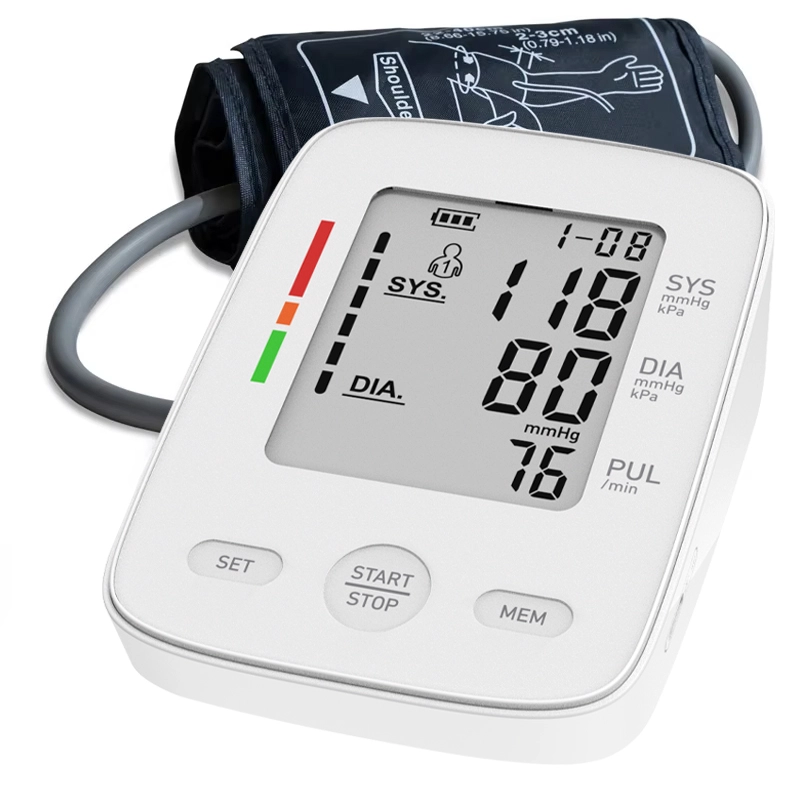
Most rechargeable blood pressure monitor models also include advanced features that go beyond basic measurement, such as dual-user memory profiles, irregular heartbeat detection, color-coded risk indicators, wireless connectivity for smartphone app syncing, and large backlit displays for easy reading in any lighting condition.
2. Rechargeable vs. Battery-Operated: Cost Comparison Over Time
The financial advantage of a rechargeable blood pressure monitor becomes clear when you calculate the long-term costs. Consider a patient who monitors blood pressure four to five times per week, approximately twenty times per month or 240 times per year.
A battery-operated monitor typically requires four AA batteries. With frequent use, batteries drain every two to three months, requiring four to six replacement sets per year. At a conservative estimate of two dollars per set, that is eight to twelve dollars annually on batteries alone. Over three years, the battery cost reaches twenty-four to thirty-six dollars. Over five years, forty to sixty dollars.
A rechargeable blood pressure monitor has zero battery replacement cost. The electricity consumed per charge is negligible, measured in fractions of a cent. Even if the rechargeable model costs ten to fifteen dollars more at initial purchase, the buyer recovers that difference within the first year and continues saving for the remaining lifespan of the device.
The EasyCare cost analysis model demonstrates that over three to five years, a rechargeable blood pressure monitor offers clearly better return on investment than a battery-operated equivalent, especially for households where multiple family members monitor their blood pressure regularly.
3. Lithium-Ion Battery Technology and Charging Convenience
Modern rechargeable blood pressure monitor devices use lithium-ion battery technology, the same chemistry found in smartphones, laptops, and electric vehicles. Lithium-ion offers several advantages over older nickel-cadmium or alkaline cells:
High energy density. A small, lightweight lithium-ion cell can store enough energy to power a blood pressure monitor for 200 to 300 measurements on a single charge, typically lasting two to three months of regular use before recharging is needed.
No memory effect. Unlike older rechargeable batteries, lithium-ion cells do not suffer from the memory effect, meaning they can be topped up at any time without reducing their overall capacity.
Long cycle life. A quality lithium-ion battery in a rechargeable blood pressure monitor is rated for 500 or more full charge cycles. At four charges per year, that translates to a battery lifespan of over ten years, far exceeding the typical device replacement cycle.
USB charging convenience. The ability to charge via USB-C means the monitor can be powered from a wall adapter, a computer port, a power bank, or even a car charger. This universality eliminates the need to carry spare batteries when traveling.
4. Does Power Source Affect Measurement Accuracy?
A common concern among buyers is whether a rechargeable blood pressure monitor is less accurate than a battery-operated model. The short answer is no. Measurement accuracy depends on the sensor technology, oscillometric calibration algorithm, cuff quality, and clinical validation status of the device, not on the power source.
As long as the battery is adequately charged, the internal voltage regulation circuitry ensures consistent power delivery to the pressure sensor and microprocessor. The EasyCare engineering team confirmed that power source does not impact reading accuracy if the battery level is sufficient. Most rechargeable blood pressure monitor models include a low-battery warning that alerts the user when charge falls below the threshold needed for accurate measurement.
When choosing a rechargeable blood pressure monitor, the same accuracy standards apply as for any other device. Look for clinical validation against AAMI, ESH, or ISO 81060-2:2018 protocols, and check the AMA Validated Device Listing at validatebp.org to confirm the model has been independently tested.
5. Environmental Impact: Reducing Battery Waste
The environmental case for a rechargeable blood pressure monitor is compelling. Disposable batteries contain heavy metals including lead, mercury, and cadmium, which can leach into soil and groundwater when improperly disposed of. According to the Environmental Protection Agency, Americans discard over three billion batteries annually, contributing significantly to toxic household waste.
A rechargeable blood pressure monitor that uses a lithium-ion cell eliminates the need for approximately 20 to 30 disposable batteries per year for a single user. Over a five-year device lifespan, that is 100 to 150 batteries saved from landfill. For a household with two users sharing one device, the savings double.
Lithium-ion batteries are also recyclable. Major electronics retailers and battery recycling programs accept spent lithium-ion cells, ensuring that the materials, including cobalt, nickel, and lithium, can be recovered and reused. Choosing a rechargeable blood pressure monitor is a practical step toward sustainable healthcare consumption without compromising on measurement quality.
6. Why Rechargeable Monitors Are Ideal for Elderly Users
For elderly users, a rechargeable blood pressure monitor offers significant practical advantages. Many seniors live alone or have limited mobility, making trips to the store for replacement batteries a frustrating chore. Battery replacement itself can be difficult for users with arthritis, poor vision, or limited manual dexterity, as small battery doors and stiff contacts require fine motor control.
A rechargeable blood pressure monitor solves these problems. The user simply plugs the device into a wall outlet using the included USB cable, the same way they charge their phone, and the device is ready for use within a few hours. No battery door to open, no batteries to insert with correct polarity, no risk of battery leakage damaging the device.
The NCOA review of home blood pressure monitors noted that ease of use is a critical factor for senior users, and devices that minimize operational complexity are strongly preferred. A rechargeable blood pressure monitor with one-touch measurement, large backlit display, and voice announcement features represents the ideal combination of simplicity and functionality for aging populations managing hypertension independently.
7. Finicare Rechargeable Blood Pressure Monitor Technology
Finicare was established in 2017 and is a high-tech enterprise integrating research and development, manufacturing, and sales. Headquartered in Shenzhen, China, the company specializes in electronic blood pressure monitors, pulse oximeters, infrared thermometers, mesh nebulizers, and other home medical devices. Finicare products are exported to more than eighty countries across Europe, North America, the Middle East, and Southeast Asia.
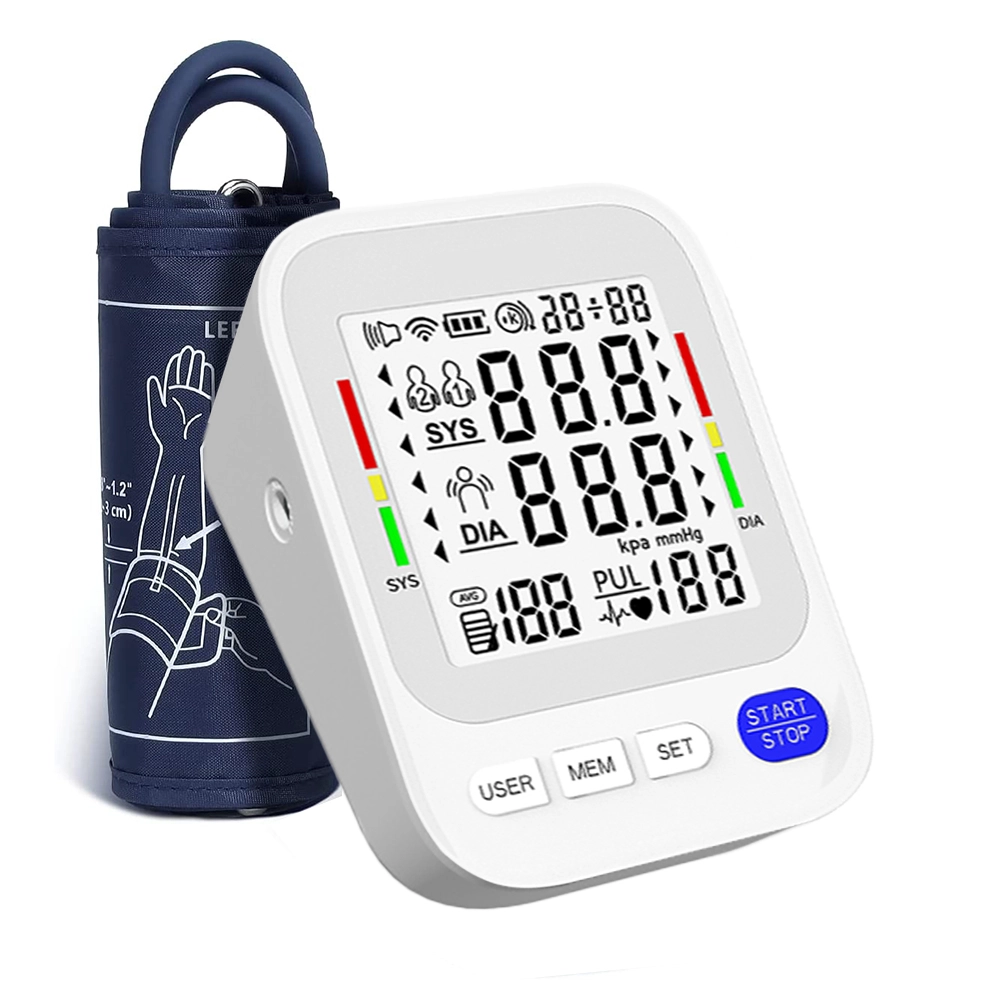
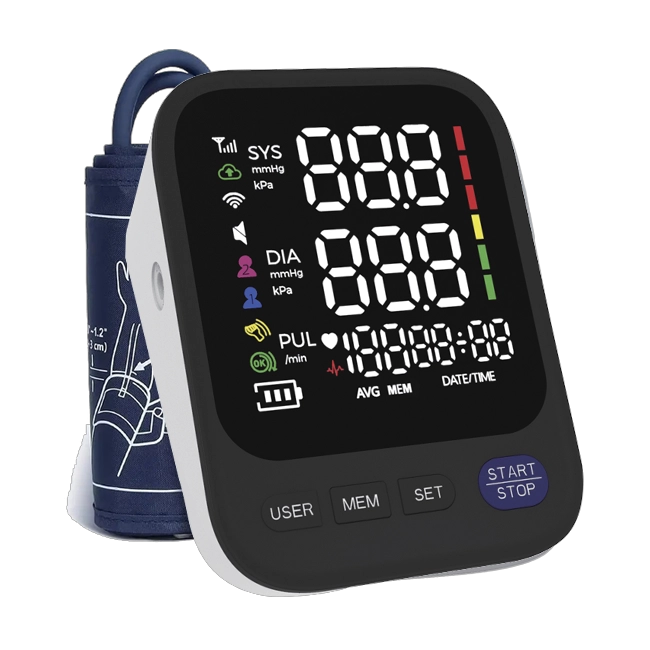
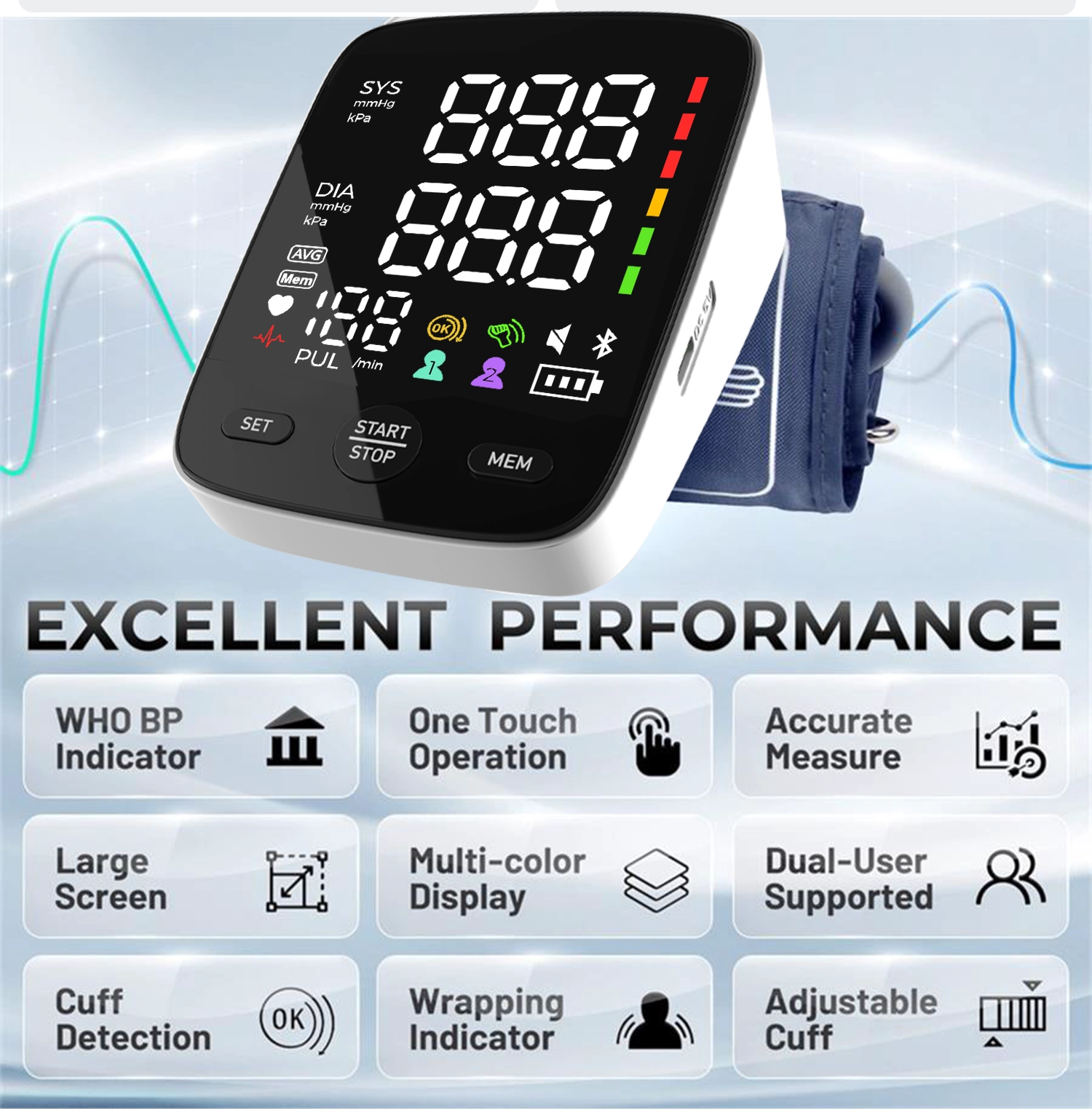
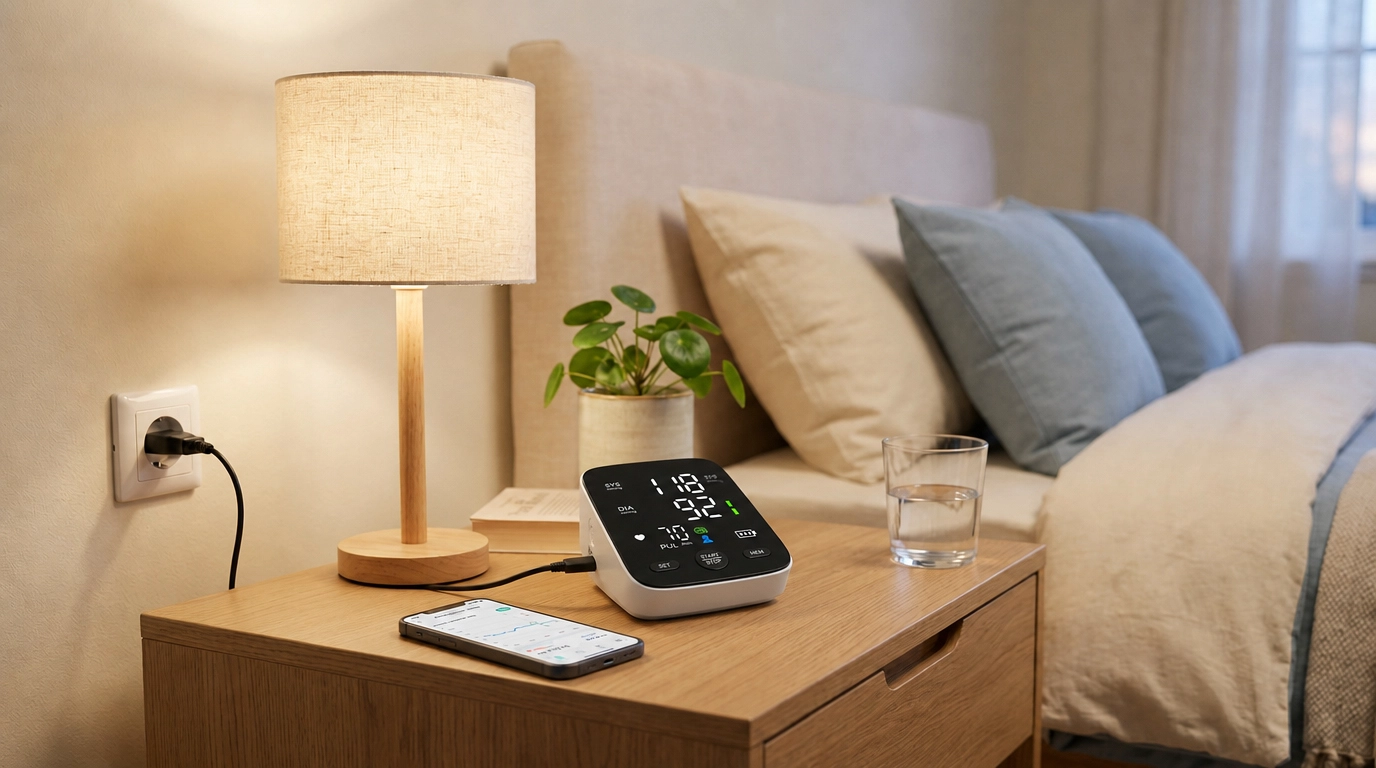
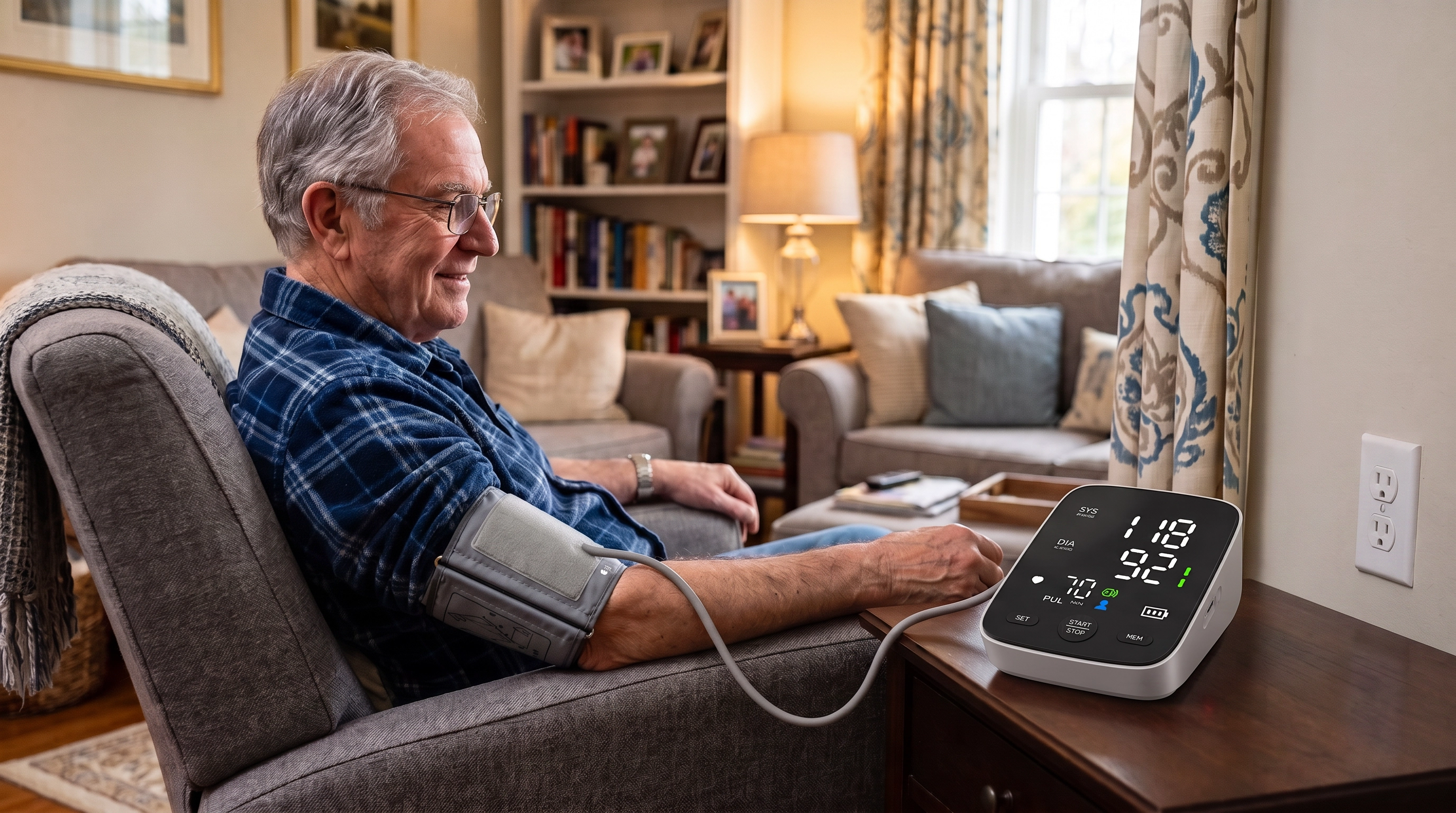
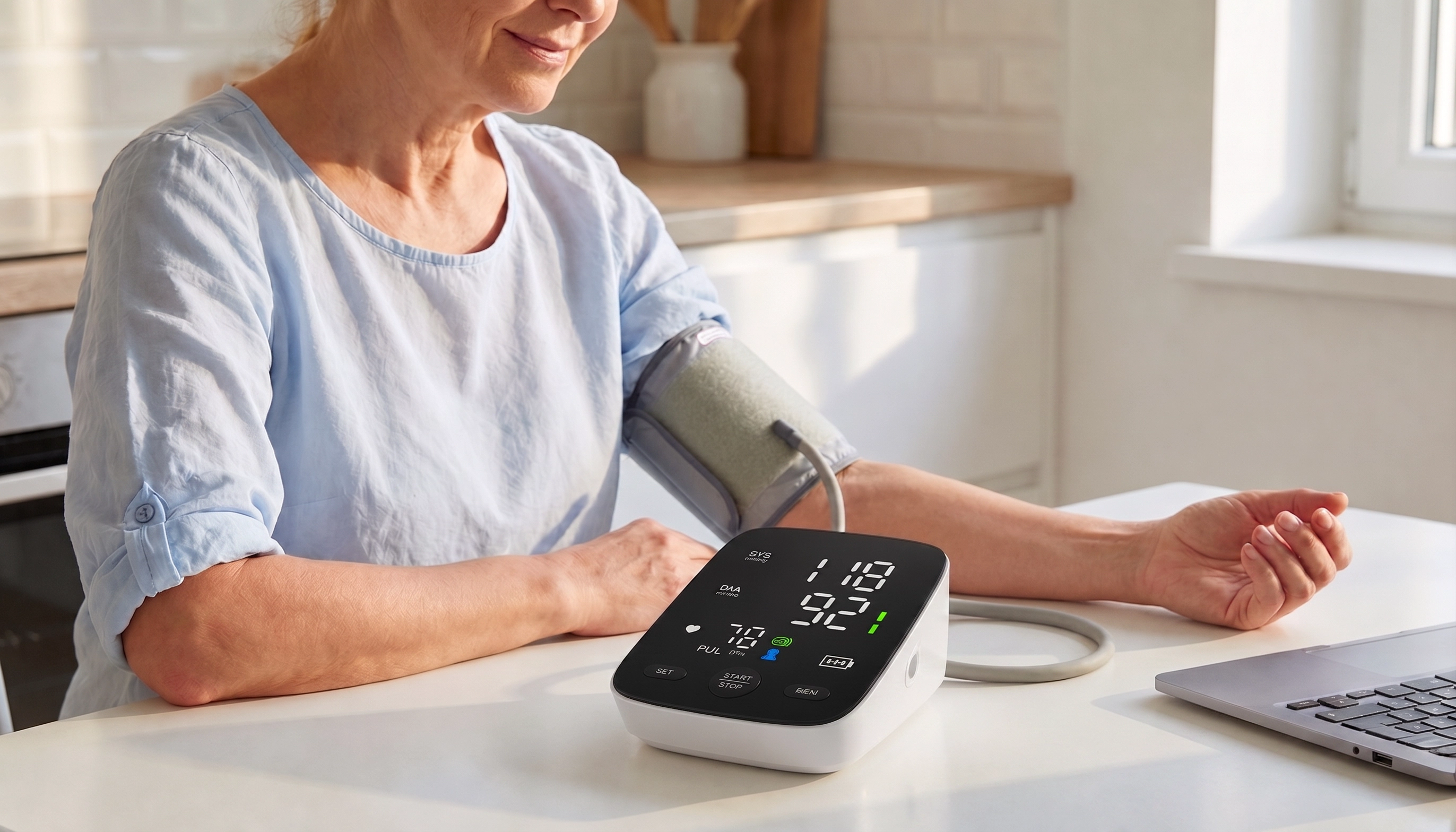
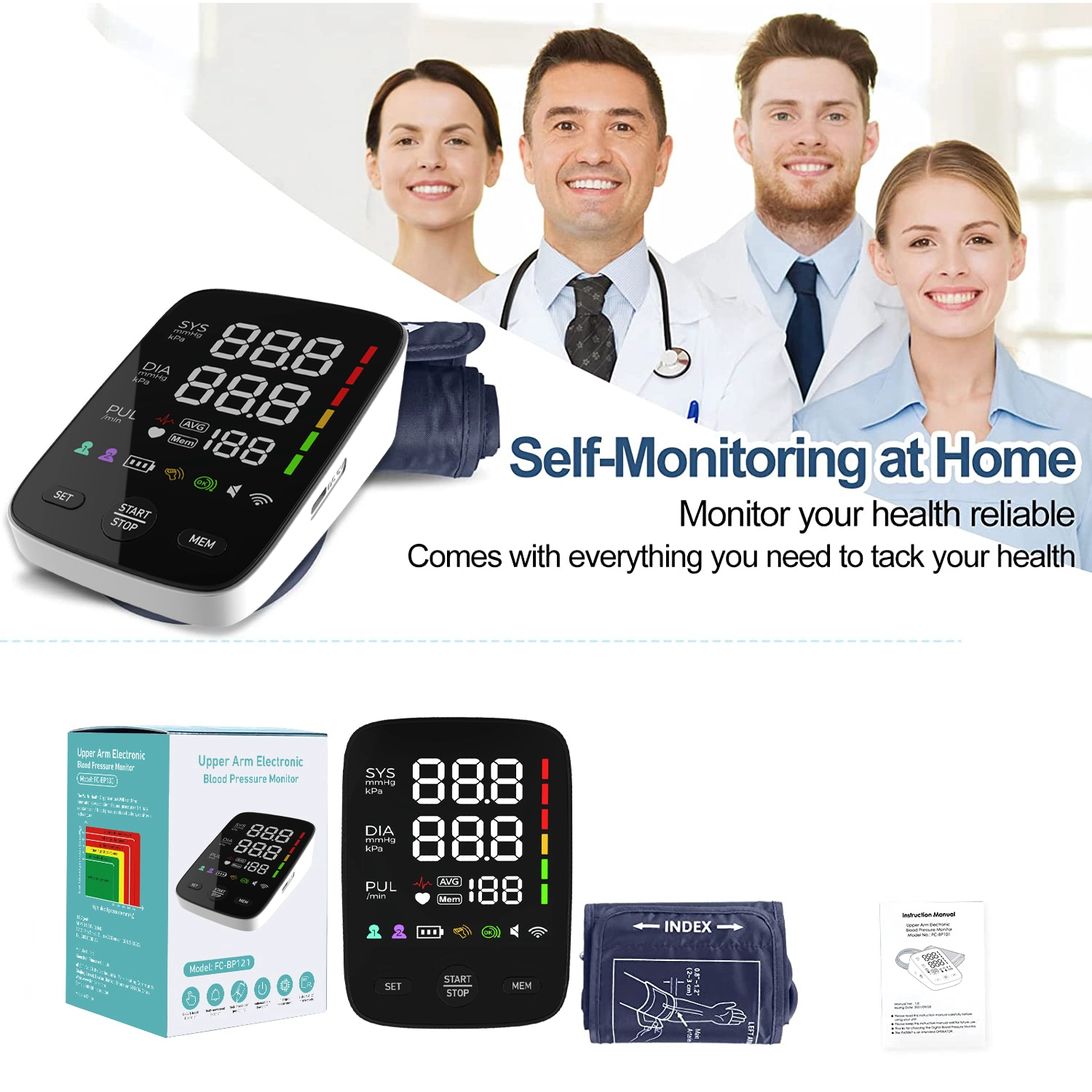
The Finicare BP121-LED is a rechargeable blood pressure monitor designed for everyday home use. It features a white plastic body with rounded corners and a black front panel housing a large LED display that shows systolic, diastolic, and pulse readings simultaneously in large white digits. A vertical color-coded health indicator bar on the right side of the display uses three segments, red at the top, yellow in the middle, and green at the bottom, to provide instant visual feedback on blood pressure category without requiring the user to interpret numerical values.
Three physical buttons provide intuitive operation: a small circular SET button on the left for configuration, a larger circular START/STOP button in the center for one-touch measurement, and a small circular MEM button on the right for reviewing stored readings. The device supports dual-user profiles with onboard memory, displayed as green and purple person icons on the screen. A side charging port enables USB charging of the built-in lithium-ion battery. The included gray fabric cuff supports arm circumferences from 22 to 42 centimeters (8.7 to 16.5 inches), covering both regular and large users.
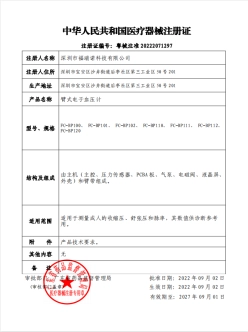
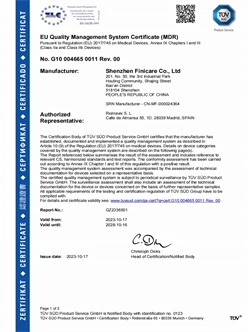
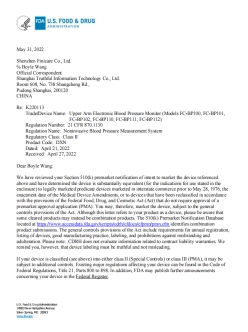
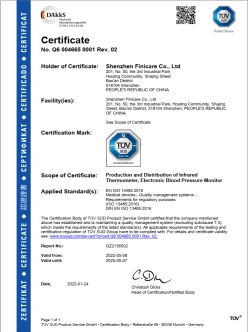
Every Finicare rechargeable blood pressure monitor is manufactured under ISO 13485 quality management, carries FDA 510(k) clearance and CE MDR marking, and undergoes incoming inspection, in-process quality control, final testing, and outbound audit before shipment. The display includes a battery level icon, a wireless connectivity indicator, and a heart rate waveform icon. For OEM and ODM partners, Finicare offers customization including multilingual voice prompts, custom cuff sizing, and connectivity integration.
8. USB-C Charging and Travel-Friendly Design
The shift to USB-C charging has transformed the rechargeable blood pressure monitor from a niche feature into a mainstream convenience. USB-C is now the universal charging standard for smartphones, tablets, laptops, and countless other consumer electronics. This means a rechargeable blood pressure monitor with a USB-C port can be charged using the same cable and wall adapter the user already owns, eliminating the need to carry a dedicated charger.
For travelers, this is particularly valuable. A rechargeable blood pressure monitor can be charged from a laptop USB port during a flight, from a portable power bank while camping, or from a car USB adapter during a road trip. The device takes approximately two to three hours to reach full charge and then operates for two to three months of regular use before needing recharging.
The NCOA testing team noted that portability is an important consideration for users who travel frequently or are away from home. A rechargeable blood pressure monitor with USB-C charging is inherently more travel-friendly than a battery-operated model, as the user does not need to pack spare batteries or worry about finding the correct battery size in a foreign country.
9. Key Features to Look for When Buying
When evaluating a rechargeable blood pressure monitor, consider these essential features:
Battery capacity and life. Look for a device rated for at least 200 measurements per charge. The manufacturer should specify the estimated number of uses or months of typical use between charges.
Charging port type. USB-C is strongly preferred over older micro-USB designs, as it is more durable, reversible, and aligns with current smartphone charging standards.
Clinical validation. Verify that the device has been validated against AAMI, ESH, or ISO 81060-2:2018 standards. Check validatebp.org for published validation reports.
Cuff range. Ensure the included cuff covers your arm circumference. Standard adult cuffs typically fit 22 to 42 centimeters. If you need a larger size, look for models that support extended ranges.
Display readability. A large LED or LCD screen with clearly labeled systolic, diastolic, and pulse readings is essential. Color-coded risk indicators provide instant visual feedback.
Memory and multi-user support. Look for at least 90 readings of onboard storage per user and support for two or more user profiles.
Irregular heartbeat detection. This feature flags potential atrial fibrillation during measurement, providing an early warning that should prompt medical follow-up.
Low-battery indicator. The device should clearly alert the user when battery charge is low enough to potentially affect measurement accuracy.
10. The Future of Power in Home Medical Devices
The rechargeable blood pressure monitor represents a broader trend in home healthcare: the transition from disposable to rechargeable power across all categories of personal medical devices. Pulse oximeters, infrared thermometers, and mesh nebulizers are increasingly adopting built-in lithium-ion batteries with USB charging.
Finicare's R&D team is actively developing next-generation rechargeable blood pressure monitor technology with features including fast charging capability that provides 50 measurements from a 15-minute charge, solar-assisted charging for off-grid use, and energy-harvesting technology that extends battery life through measurement-driven power generation. These innovations will further reduce the environmental footprint of home health monitoring while improving user convenience.
The global blood pressure monitoring devices market was valued at approximately USD 5.7 billion in 2025 and is projected to reach USD 8.08 billion by 2034, driven in part by the adoption of smart, connected, and rechargeable devices. As reimbursement policies for remote patient monitoring expand and consumers increasingly prioritize sustainability, the rechargeable blood pressure monitor is poised to become the standard rather than the exception.
Summary
A rechargeable blood pressure monitor uses a built-in lithium-ion battery charged via USB, eliminating the need for disposable AA or AAA batteries. Over three to five years of regular use, a rechargeable blood pressure monitor saves 100 to 150 batteries from landfill and recovers its higher initial purchase price within the first year. Key benefits include lower long-term cost, environmental sustainability, and superior convenience for elderly users who may struggle with battery replacement. When choosing a rechargeable blood pressure monitor, prioritize USB-C charging, clinical validation (AAMI, ESH, or ISO 81060-2), a cuff range that covers your arm circumference, dual-user memory, and irregular heartbeat detection. The Finicare BP121-LED exemplifies these standards with its FDA 510(k) clearance, ISO 13485 manufacturing, CE MDR marking, large LED display with color-coded risk indicator, dual-user profiles, USB charging port, and gray fabric cuff supporting arm circumferences from 22 to 42 centimeters. By choosing a rechargeable blood pressure monitor, patients can achieve accurate, convenient, and sustainable home blood pressure monitoring for years to come.