




How Does an Infrared Thermometer Work? A Complete Guide to Thermopile Technology and Body Temperature Measurement
Preface
Infrared thermometers became a daily tool during the pandemic, yet most people who use one every morning have only a vague idea of what happens between pointing the device at a forehead and reading a number on the screen. That gap matters, because understanding the physics explains both the strengths of the technology and the reasons a reading can be wrong.
This guide answers the question how does an infrared thermometer work in full technical detail, from the electromagnetic radiation emitted by every object to the thermopile sensor that converts that radiation into a voltage, and from the signal processing inside the device to the clinical evidence behind forehead fever screening. It also covers the practical side: measurement distance, emissivity, ambient conditions, user technique, and the difference between medical and industrial instruments. The article is written for parents and caregivers, nurses and clinic staff, procurement teams evaluating devices, engineering students, and anyone who wants to use an infrared thermometer correctly rather than just press a button. By the end, the reading on the display will make sense as the end of a chain of measurable physical events.
Table of Contents
- 1. What an Infrared Thermometer Actually Measures
- 2. The Physics: Infrared Radiation, Emissivity, and the Seebeck Effect
- 3. Inside the Sensor: How a Thermopile Converts Heat Into a Reading
- 4. From Voltage to Temperature: Signal Processing and Compensation
- 5. Why Forehead Measurement Works for Fever Screening
- 6. Accuracy Factors: Distance, Environment, and Technique
- 7. Medical vs Industrial Infrared Thermometers
- 8. Finicare IR213: The Technology in a Practical Device
- 9. Buying, Using, and Maintaining an Infrared Thermometer
1. What an Infrared Thermometer Actually Measures
Every object with a temperature above absolute zero emits electromagnetic radiation in the infrared band, and the intensity and wavelength distribution of that radiation depend on the object's surface temperature. An infrared thermometer collects a portion of this radiation, focuses it onto a detector, and calculates the temperature of the surface that emitted it. No probe touches the skin, no heat flows from the patient to the device, and no contact occurs at all. This is the short answer to how does an infrared thermometer work: it measures emitted radiation, not conducted heat.
The distinction between surface temperature and core temperature is the single most important concept in medical infrared thermometry. A forehead thermometer measures the temperature of the skin over the frontal region and the temporal artery area, then relies on the relationship between skin temperature and internal body temperature to estimate what clinicians call core temperature. That relationship is strong enough for fever screening when the device is validated, the environment is controlled, and the user follows instructions, which is why the technology is accepted in hospitals, airports, schools, and homes. It is not exact, however, and no non-contact thermometer reads the temperature inside the body directly.
Non-contact measurement also delivers the hygiene benefit that made infrared thermometers ubiquitous. Because the device never touches the person being measured, cross-contamination between patients is reduced and disinfection between readings becomes simple. The FDA describes non-contact infrared thermometers as devices that measure surface temperature to reduce cross-contamination, which is precisely why they became the default screening tool in public settings.
2. The Physics: Infrared Radiation, Emissivity, and the Seebeck Effect
The physics behind how does an infrared thermometer work begins with thermal radiation. Any surface emits infrared energy at a rate that rises steeply with temperature, following the Stefan-Boltzmann relationship: doubling the absolute temperature increases emitted power by a factor of sixteen. Human skin at roughly 33 to 37 degrees Celsius emits radiation concentrated in the far-infrared band, around 8 to 14 micrometers, a range that conveniently passes through the atmosphere and through the optical filters used in thermometer sensors.
Not all surfaces emit equally. Emissivity describes how efficiently a surface radiates compared with a perfect blackbody, on a scale from 0 to 1. Human skin has an emissivity of approximately 0.98, very close to a blackbody, which is fortunate for medical thermometry: the device can assume a fixed emissivity value and still obtain consistent readings. Shiny metal, polished glass, and mirrors have low emissivity and reflect ambient radiation instead of emitting their own, which is why aiming an infrared thermometer at a chrome surface produces meaningless numbers.
The detection mechanism relies on the Seebeck effect, discovered in 1821. When two dissimilar metals are joined at both ends and the junctions sit at different temperatures, a small voltage appears across the circuit proportional to the temperature difference. A single junction produces only microvolts, so engineers connect many thermocouples in series to build a thermopile, multiplying the signal into a range that practical electronics can amplify and digitize. The hot junctions absorb incoming infrared radiation, the cold junctions sit on the sensor substrate at a known reference temperature, and the resulting voltage encodes the temperature difference between the target surface and the sensor itself.
3. Inside the Sensor: How a Thermopile Converts Heat Into a Reading

Thermopile sensors are calibrated against blackbody references before assembly.
The next stage of how does an infrared thermometer work takes place inside a component smaller than a grain of rice. A modern thermopile sensor is a micromachined silicon chip a few millimeters across. Its core is a thin membrane of silicon nitride or a similar material, suspended over a cavity etched into the substrate. The membrane has extremely low thermal mass, so it heats and cools almost instantly when infrared radiation strikes it. On the membrane sit the hot junctions of the thermocouple series, covered by a black absorbing layer that converts incident radiation into heat. The cold junctions rest on the thick silicon frame, which stays close to ambient temperature.
Two additional components complete the sensor. A thermistor integrated into the package measures the reference temperature of the cold junctions, because the output voltage depends on the difference between hot and cold junctions rather than on absolute temperature. Without this reference measurement, the device could not separate target temperature from sensor temperature. An optical filter, usually silicon-based, blocks visible light and passes only the 8 to 14 micrometer infrared band, preventing sunlight and room lighting from corrupting the signal.
Optics determine where the sensor looks. A Fresnel lens or a small reflector collects radiation from a defined cone and directs it onto the membrane, establishing the field of view. The ratio of measurement distance to the diameter of the measured spot, called the distance-to-spot ratio, tells the user how far away the target must be for the sensor to see only the intended surface. Medical forehead thermometers use short fixed distances, typically 1 to 5 centimeters, with a field of view sized for a forehead patch. Industrial thermometers use longer distances and narrower fields, sometimes with laser sighting to show where the spot lands.
The complete chain inside the device runs from photons to voltage to digits. Infrared radiation heats the membrane, the thermopile generates a microvolt-level signal, a low-noise amplifier raises it to a usable level, an analog-to-digital converter digitizes it, and a microcontroller applies calibration constants, emissivity assumptions, and ambient compensation to calculate the target temperature. The whole process, including thermal settling, takes about one second in a well-designed medical thermometer.
4. From Voltage to Temperature: Signal Processing and Compensation
Raw sensor output is not yet a temperature. The microcontroller must solve the radiometric equation that relates measured radiation to surface temperature, using the fixed emissivity assumption for skin, the cold-junction reference, and factory calibration data stored in memory. The calibration process, performed against blackbody references at multiple temperatures, corrects for sensor-to-sensor variation and lens transmission losses. Without this step, two devices of identical design could disagree by more than a degree.
Ambient compensation is equally important. When the thermometer moves from a cold car into a warm clinic, the sensor housing, lens, and internal electronics have not yet reached thermal equilibrium, and their changing temperatures distort the measurement. Good devices include algorithms that model the sensor's own thermal state and adjust the output accordingly. This is why manufacturers specify an operating temperature range, commonly 10 to 40 degrees Celsius, and why instructions tell users to let the device acclimate to indoor conditions before measuring. The same principle applies to the patient: a person arriving from cold outdoor air needs 15 to 30 minutes indoors before a forehead reading is representative.
The final display stages add clinical convenience. The microcontroller checks the result against fever thresholds, activates color-coded indicator lights, sounds an alarm, and stores the reading in memory. Resolution is typically 0.1 degree Celsius, while declared accuracy for body temperature mode is commonly plus or minus 0.2 degrees Celsius within the clinically relevant range of roughly 35 to 42 degrees Celsius. Those two numbers describe different properties: resolution is the size of the smallest displayed step, and accuracy is how close the displayed value is likely to be to the true reference temperature.
Everything described so far is a chain of calibration and compensation decisions, which explains why answering how does an infrared thermometer work fully requires understanding the firmware as much as the sensor. Two devices with identical thermopiles can perform very differently if one has careful multi-point calibration and ambient modeling and the other uses a single factory offset.
5. Why Forehead Measurement Works for Fever Screening
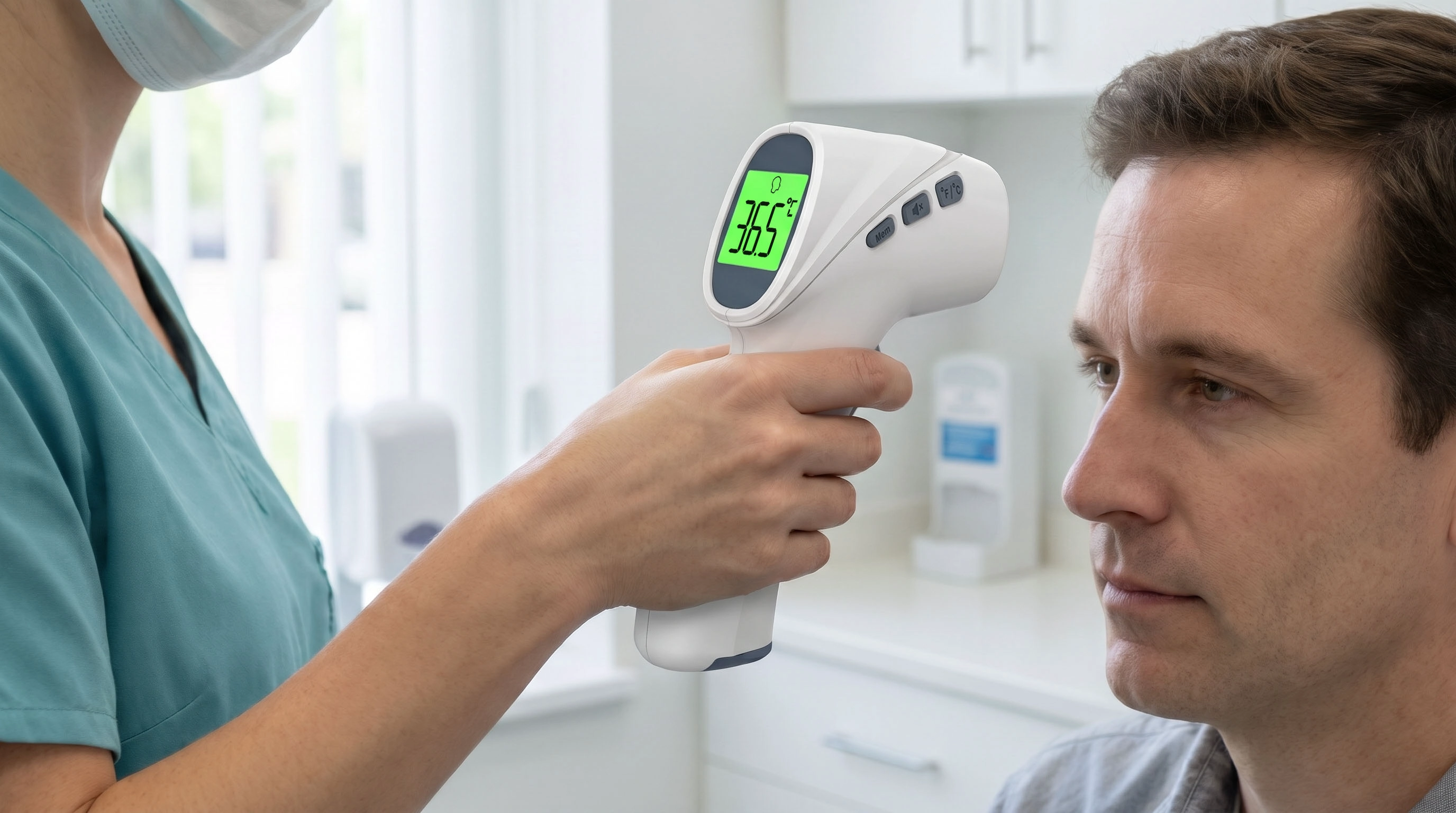
A one-second forehead reading at home, with the device held 1-5 cm from the skin.
The answer to how does an infrared thermometer work only becomes clinically useful when the sensor is aimed at a site that tracks core temperature, and the forehead is the best exposed candidate. The forehead region overlays the frontal branch of the temporal artery, a superficial vessel that carries blood from the external carotid circulation. Skin temperature over this area tracks internal temperature more closely than most other exposed surfaces, which is why forehead thermometers became the reference site for non-contact screening. When the body raises its set point during fever, vasoconstriction in the extremities and increased flow in the head and neck make the forehead a relatively reliable indicator.
Clinical research on infrared temperature devices has generally found acceptable agreement with reference thermometry when the devices are used correctly, with typical biases within half a degree Celsius and reasonably high sensitivity for detecting fever in screening settings. Performance depends on device quality, ambient conditions, and technique, and researchers consistently note that non-contact devices cannot replace contact thermometry in critical clinical decisions. The FDA likewise emphasizes that these devices measure surface temperature and must be used according to manufacturer instructions, with normal body temperature often cited in the range of 97 to 99 degrees Fahrenheit.
The practical advantages explain the technology's persistence despite these caveats. A qualified device produces a reading in about one second, works without waking a sleeping child, requires no probe covers or disinfection between healthy users, and can screen large groups quickly. For school entry checks, clinic triage, workplace screening, and home monitoring, that combination of speed and hygiene outweighs the modest accuracy trade-off, provided the user understands the conditions under which the reading is valid.
The limitations are equally real. Forehead skin cools quickly in drafts, warms in direct sun, and changes with sweating, cosmetics, and recent exercise. A single reading taken in a cold doorway is closer to a measurement of the doorway than of the patient, which is why best practice calls for indoor acclimation, repeated measurements, and confirmation with a contact thermometer when a result seems inconsistent with the patient's condition.
6. Accuracy Factors: Distance, Environment, and Technique
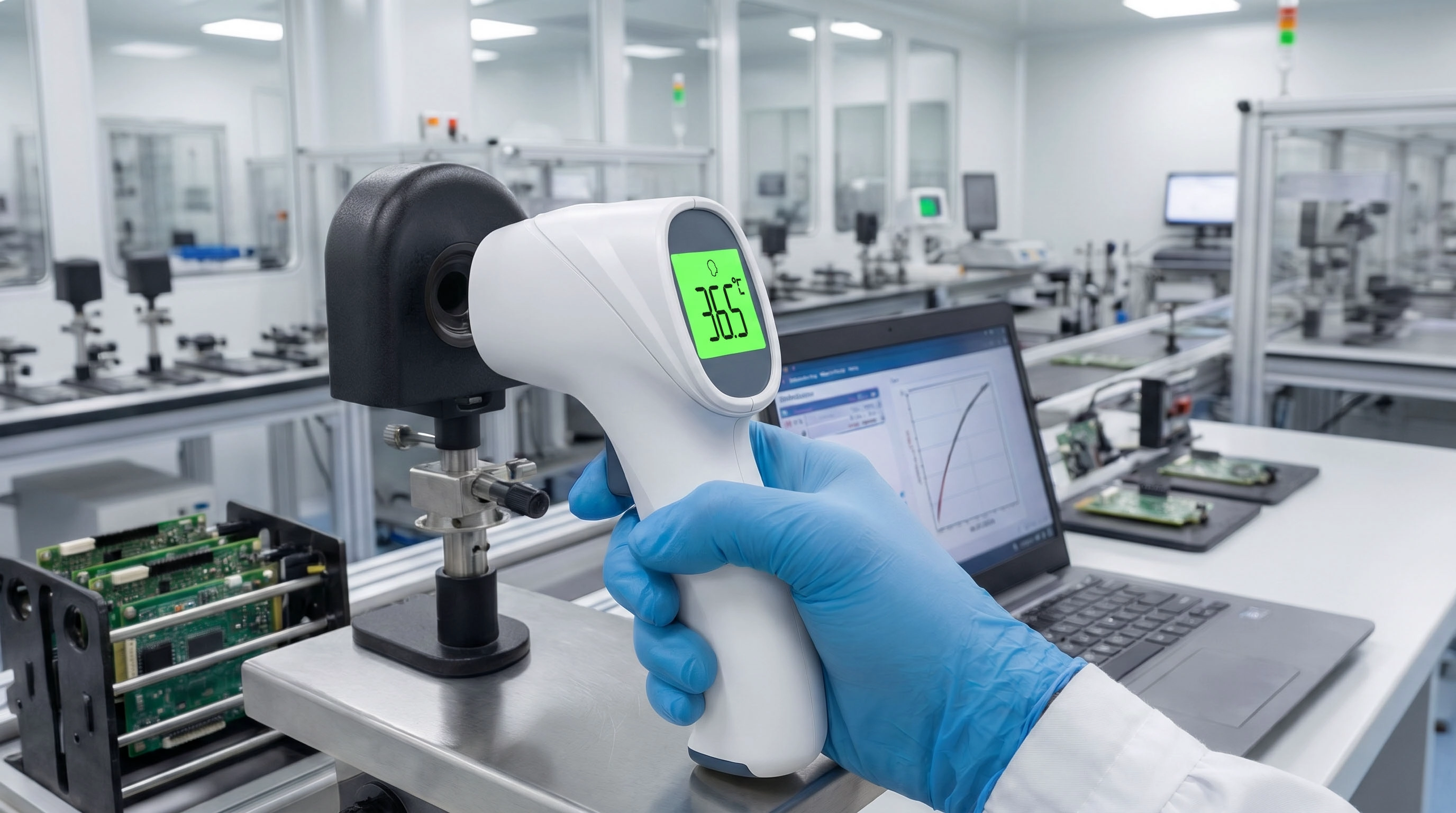
Clinic triage screening: distance, angle, and a stable indoor environment determine accuracy.
Understanding how does an infrared thermometer work at the physics level translates directly into user discipline. Six factors dominate real-world accuracy.
Distance is first. The sensor averages everything inside its field of view, so holding the device too far away mixes forehead radiation with background radiation from the room. Medical thermometers are designed for a specific short distance, and many models include a distance indicator or instructions to touch the forehead lightly with the probe housing to fix the gap.
Emissivity assumptions come second. The device is calibrated for skin at approximately 0.98, so it cannot read through clothing, thick cosmetics, or a wet towel. Forehead sweat both lowers surface temperature through evaporation and changes the optical properties of the skin, producing falsely low readings.
Ambient conditions rank third. Direct sunlight, air-conditioning vents, heaters, and open windows all shift skin temperature independently of core temperature. The device itself also needs to be within its operating range, typically 10 to 40 degrees Celsius, and acclimated to the room.
Technique follows. The sensor must be perpendicular to the forehead and aimed at the center, not the hairline or the temple. Hair, headbands, and hats block infrared radiation. The user should wait for the completion beep rather than pulling the device away early.
Battery state and lens cleanliness matter more than users expect. A weak battery can affect the backlight, the sensor bias, or both, and a smudged lens scatters radiation and reduces signal strength. Cleaning the lens with an alcohol swab and allowing it to dry restores performance.
Finally, repetition resolves ambiguity. When a reading is elevated or implausibly low, the correct response is to repeat the measurement after a brief pause, in a stable environment, and to compare with a second method if the result would influence care. No single infrared reading is a diagnosis.
7. Medical vs Industrial Infrared Thermometers
The same thermopile principle powers devices built for entirely different jobs, and confusing the two categories is a common buying mistake.
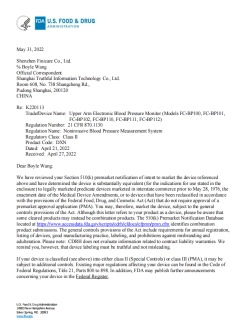
Medical infrared thermometers are optimized for the human body. They use a fixed emissivity near 0.98, a narrow body-temperature range, a short measurement distance, and firmware tuned for forehead and sometimes ear or object modes. They are regulated as medical devices: in the United States they typically require 510(k) clearance as Class II devices, and performance is evaluated against standards such as ASTM E1965 and ISO 80601-2-56. Clinical validation data, fever alarms, and color indicators belong to this category.
Industrial infrared thermometers are optimized for surfaces. They offer adjustable emissivity from roughly 0.1 to 1.0, measurement ranges extending from below freezing to several hundred or even thousands of degrees, laser sighting, and distance-to-spot ratios such as 12:1 that let users measure from a safe distance. They are not clinically validated for body temperature and should not be used for fever screening, even though the underlying sensor technology is the same.
A third category, consumer "forehead guns" sold without medical registration, occupies an uncomfortable middle ground. They may work as rough indicators, but they lack the calibration discipline and regulatory review that medical devices receive. Buyers who need defensible readings should check for medical device registration rather than rely on marketing language.
8. Finicare IR213: The Technology in a Practical Device
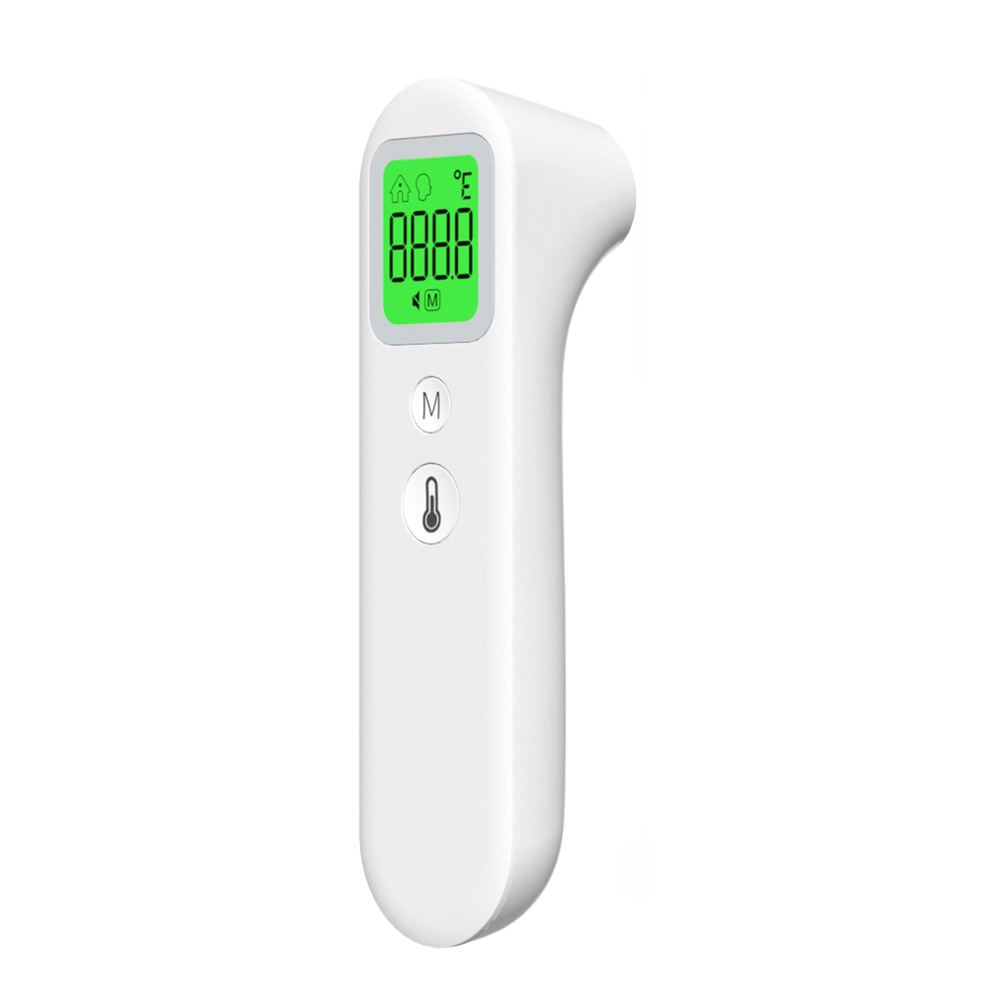
Finicare IR213 forehead thermometer: green backlit LCD, one-second reading, 35-group memory.
Finicare, established in 2017 and integrating research and development, production, and sales, is a Shenzhen-based medical device manufacturer exporting to more than 80 countries. Its product range, including thermometers, blood pressure monitors, oximeters, and nebulizers, shows how the theory above becomes a shipping product, and the IR213 forehead thermometer is a clear example of how does an infrared thermometer work in daily use.
The IR213 pairs an ergonomic white housing with a bright green backlit LCD that displays large black digits, readable in a dim nursery or a bright clinic corridor. Two round buttons sit below the display: one labeled M for memory and one marked with a thermometer icon for measurement. The device measures forehead temperature in about one second, stores 35 groups of readings for trend review, switches between Celsius and Fahrenheit, measures object and room temperature in a separate mode, and includes a baby mode plus a three-color indicator light and fever alarm that turn the raw number into an immediately understandable signal.
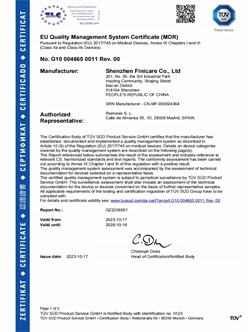
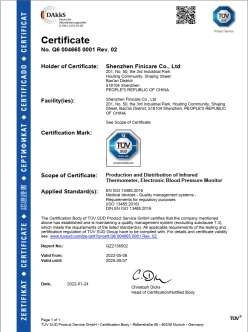
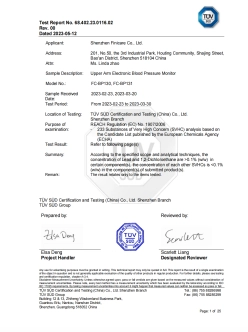
Inside, the device follows the architecture described earlier: an infrared sensor with fixed skin emissivity, ambient compensation firmware, factory calibration, and a microcontroller that drives the display and alarm logic. The certified product file includes FDA 510(k), CE (MDR), TGA, MDL, UKRP, NMPA, FSC, FCC, and RoHS certifications, while the factory operates under ISO 13485 with MDSAP recognition and BSCI social compliance. Every certificate can be verified with its issuing body, and buyers evaluating the device are encouraged to do so.
9. Buying, Using, and Maintaining an Infrared Thermometer
Buyers should start with documentation. Confirm that the device is registered as a medical device in the target market, that its declared accuracy covers the body-temperature range, and that the manufacturer can supply clinical validation data and calibration records. Check the standards cited in the test file, typically ASTM E1965 and ISO 80601-2-56 for clinical thermometers, and verify certificates with the issuing body rather than accepting copies at face value.
Users should read the instructions once, carefully. They specify the measurement distance, the correct forehead location, the operating temperature range, the acclimation time, and the cleaning method. Following those instructions is not bureaucratic detail; it is the difference between a reading that reflects the patient and one that reflects the room.
Maintenance is simple but not optional. Clean the lens and probe housing with an alcohol swab, never immerse the device in water, replace batteries before performance degrades, and store the thermometer away from heat and direct sunlight. Clinics that depend on screening accuracy should verify devices periodically against a reference thermometer in a controlled water bath or infrared blackbody, and should retire units that drift outside their declared tolerance. A thermometer is a measuring instrument, and like any instrument it deserves periodic confirmation that it still measures what it claims. None of this maintenance changes how does an infrared thermometer work, but it keeps the device inside the accuracy its design promises.
Summary
The answer to how does an infrared thermometer work spans physics, electronics, and clinical practice. Every object emits infrared radiation proportional to its surface temperature. A thermopile sensor, built from thermocouples in series exploiting the Seebeck effect, converts that radiation into a microvolt signal, and a microcontroller applies calibration, fixed skin emissivity of about 0.98, and ambient compensation to display a temperature. Forehead measurement works because skin over the temporal artery tracks core temperature closely enough for screening, with typical clinical bias within half a degree Celsius when devices are validated and used correctly.
Accurate use depends on distance control, indoor acclimation, clean optics, correct mode selection, and repetition when a reading looks wrong. Medical devices carry 510(k) clearance and standards such as ASTM E1965, while industrial thermometers with adjustable emissivity and laser sighting are not clinical instruments. Finicare, established in 2017 and integrating R&D, production, and sales, manufactures certified home medical devices, including the IR213 forehead thermometer with its green backlit LCD, one-second reading, 35-group memory, fever alarm, and object/room modes, exported to more than 80 countries, with product certifications including FDA 510(k), CE (MDR), TGA, MDL, UKRP, NMPA, FSC, FCC, and RoHS, and factory certifications including ISO 13485, MDSAP, and BSCI. Understanding the technology is the first step toward using it well, and a device whose operation you understand is a device you can trust within its limits.
References
1. Thermopile sensors: A guide to non-contact temperature measurement - EDN. https://www.edn.com/thermopile-sensors-a-guide-to-non-contact-temperature-measurement/
2. Non-contact Infrared Thermometers - U.S. Food and Drug Administration. https://www.fda.gov/medical-devices/general-hospital-devices-and-supplies/non-contact-infrared-thermometers
3. Clinical accuracy of infrared temperature measurement devices - PMC. https://pmc.ncbi.nlm.nih.gov/articles/PMC11046542/
4. A remote infrared MEMS thermopile sensor for non-contact temperature measurement - ScienceDirect. https://www.sciencedirect.com/science/article/abs/pii/S092442472501060X