














FDA Approved Infrared Thermometer: What Buyers Need to Know Before Purchasing
Preface
When you purchase a thermometer for your family or your clinic, the label "FDA approved" carries significant weight. But what does it actually mean for an infrared thermometer to be FDA cleared, and why does it matter?
The U.S. Food and Drug Administration regulates infrared thermometers as Class II medical devices, requiring manufacturers to submit a 510(k) premarket notification demonstrating substantial equivalence to a legally marketed predicate device. In June 2025, the FDA updated its regulations, exempting certain clinical electronic thermometers from premarket notification requirements while maintaining 510(k) requirements for infrared thermometers with telethermographic functions.
This guide explains what FDA approval means for infrared thermometers, how the 510(k) process works, what performance standards apply, and how to verify that the device you are buying meets regulatory requirements. Whether you are a hospital procurement officer, a distributor sourcing products for resale, or a parent choosing a thermometer for home use, this article provides the knowledge you need to make an informed purchase.
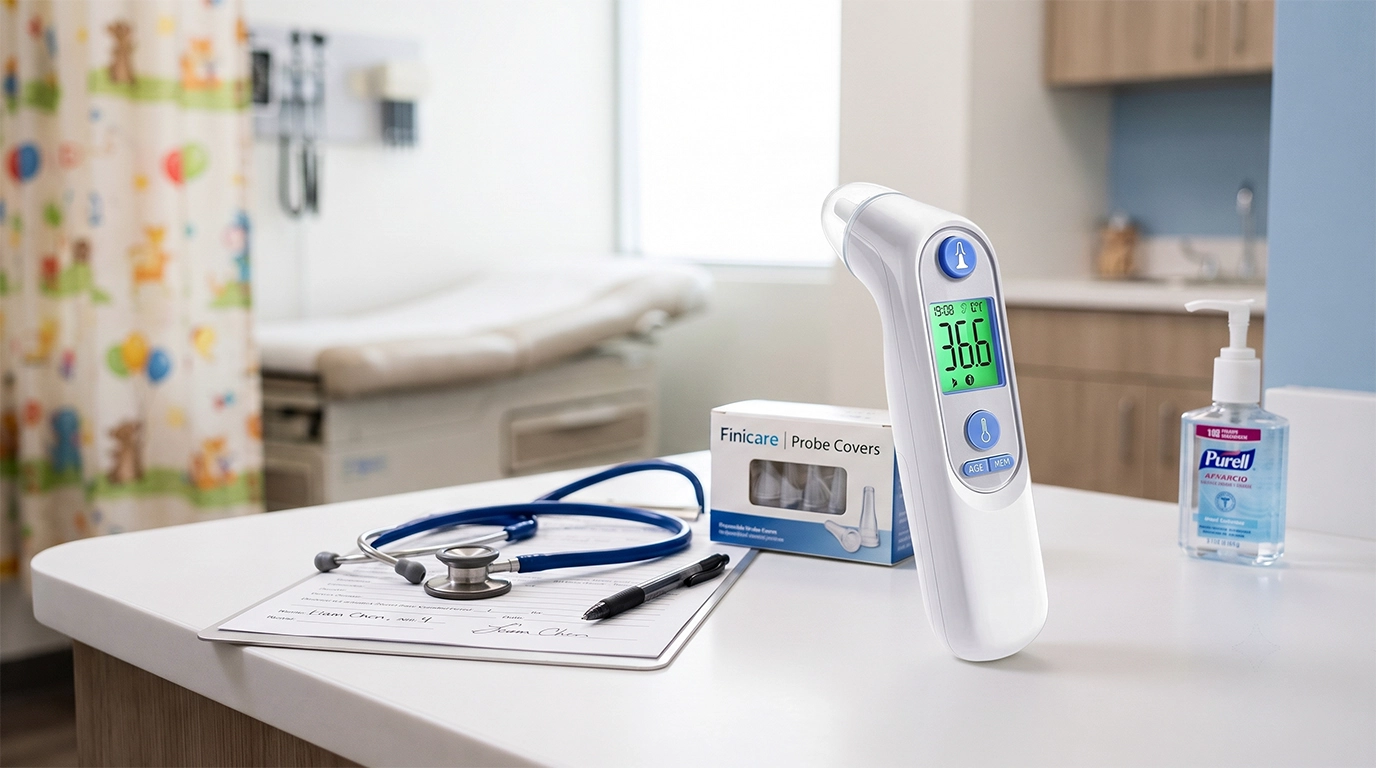
Table of Contents
1. What Does "FDA Approved" Mean for Infrared Thermometers?
2. The 510(k) Premarket Notification Process
3. FDA Classification: Product Code FLL and Regulation 880.2910
4. Performance Standards: ASTM and ISO Requirements
5. Benefits and Limitations of Non-Contact Infrared Thermometers
6. FDA Proper Use Guidelines for Accurate Readings
7. Finicare Infrared Thermometer Technology and Quality System
8. How to Verify a Thermometer Is Truly FDA Cleared
9. Common Pitfalls When Buying Infrared Thermometers
10. The Future of FDA Regulation for Infrared Thermometry
Summary
References
1. What Does "FDA Approved" Mean for Infrared Thermometers?
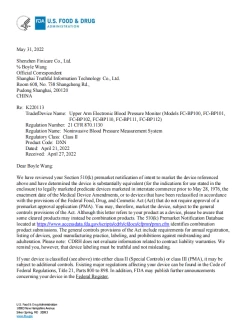
For infrared thermometers, the term "FDA approved" typically refers to FDA 510(k) clearance rather than full premarket approval (PMA). The FDA classifies clinical infrared thermometers under product code FLL as Class II medical devices, which means they require a 510(k) submission before they can be legally marketed in the United States. Unlike Class I devices that are typically exempt from premarket notification, Class II infrared thermometers must demonstrate that they are substantially equivalent to a predicate device in terms of safety and effectiveness.
A common misconception is that "FDA approved" and "FDA cleared" are interchangeable. In regulatory terms, "cleared" refers to 510(k) devices, "approved" refers to PMA devices (usually Class III), and "authorized" refers to De Novo pathway devices. When a manufacturer claims their FDA approved infrared thermometer has received market authorization, they should be able to provide a 510(k) number that can be verified in the FDA database.
2. The 510(k) Premarket Notification Process
The 510(k) process requires manufacturers to submit detailed documentation to the FDA, including:
- Device description and specifications
- Substantial equivalence comparison to a predicate device
- Performance data from clinical testing
- Software documentation (if applicable)
- Biocompatibility data for patient-contacting components
- Sterilization and shelf-life information
- Labeling and instructions for use
The FDA reviews the submission and issues a clearance letter if the device is found substantially equivalent. For an FDA approved infrared thermometer, this process typically takes 90 to 180 days from submission to clearance. The manufacturer must also register their establishment with the FDA and list the device before commercial distribution begins.
3. FDA Classification: Product Code FLL and Regulation 880.2910
Clinical infrared thermometers are classified under product code FLL and regulation number 880.2910 in the Code of Federal Regulations. This regulation describes a clinical infrared thermometer as "a device used to measure a patient's body temperature by means of an infrared sensor that detects the infrared radiation emitted by the body."
In June 2025, the FDA published a final rule exempting certain clinical electronic thermometers without telethermographic or continuous temperature measurement functions from premarket notification requirements. However, infrared thermometers with telethermographic functions — those that measure temperature from a distance without direct contact — still require 510(k) clearance. This distinction is critical for buyers evaluating whether an FDA approved infrared thermometer has completed the appropriate regulatory pathway.
4. Performance Standards: ASTM and ISO Requirements
FDA cleared infrared thermometers must comply with recognized consensus standards, including:
- ASTM E1965-98(2016): Standard Specification for Infrared Thermometers for Intermittent Determination of Patient Temperature. This standard specifies accuracy requirements, typically plus or minus 0.2 degrees Celsius in laboratory testing within a specified measurement range.
- ISO 80601-2-56:2017: Medical electrical equipment — Particular requirements for basic safety and essential performance of clinical thermometers for body temperature measurement. This standard covers electrical safety, electromagnetic compatibility, and clinical accuracy.
Manufacturers of an FDA approved infrared thermometer must include a Declaration of Conformity to these standards in their 510(k) submission or provide equivalent performance data. Buyers should look for references to ASTM E1965 and ISO 80601-2-56 in product documentation as evidence of compliance.
5. Benefits and Limitations of Non-Contact Infrared Thermometers
The FDA has identified several key benefits of non-contact infrared thermometers:
- Reduced risk of spreading disease between people being evaluated
- Easy to use, clean, and disinfect
- Rapid temperature measurement and display
- Ability to retake temperature quickly
However, the FDA also notes important limitations:
- How and where the device is used may affect measurement accuracy
- Environmental factors such as drafts, direct sunlight, and radiant heat sources can skew readings
- The close distance required for measurement still represents some risk of disease transmission
- Proper positioning perpendicular to the forehead is essential for accuracy
Understanding these benefits and limitations is fundamental to using an FDA approved infrared thermometer correctly and interpreting its results with confidence.
6. FDA Proper Use Guidelines for Accurate Readings
The FDA provides specific guidelines for the proper use of non-contact infrared thermometers:
- Use in a draft-free space, out of direct sunlight and away from radiant heat sources.
- Ensure environmental temperature is between 60.8 and 104 degrees Fahrenheit (16-40 degrees Celsius) with relative humidity below 85 percent.
- Place the device in the testing environment for 10 to 30 minutes before use to allow temperature equilibration.
- Ensure the forehead test area is clean, dry, and unobstructed.
- Hold the sensing area perpendicular to the forehead.
- Follow the manufacturer's specified measurement distance.
- Do not touch the sensing area, and keep the sensor clean and dry.
- Clean and disinfect between uses according to manufacturer instructions.
These guidelines apply to every FDA approved infrared thermometer regardless of brand, and following them is essential for obtaining clinically reliable readings.
7. Finicare Infrared Thermometer Technology and Quality System

Finicare was established in 2017 and is a high-tech enterprise integrating R&D, production, and sales. Headquartered in Shenzhen, China, the company specializes in infrared thermometers, electronic blood pressure monitors, pulse oximeters, and other home medical devices. Its products are exported to more than 80 countries across Europe, North America, the Middle East, and Southeast Asia.
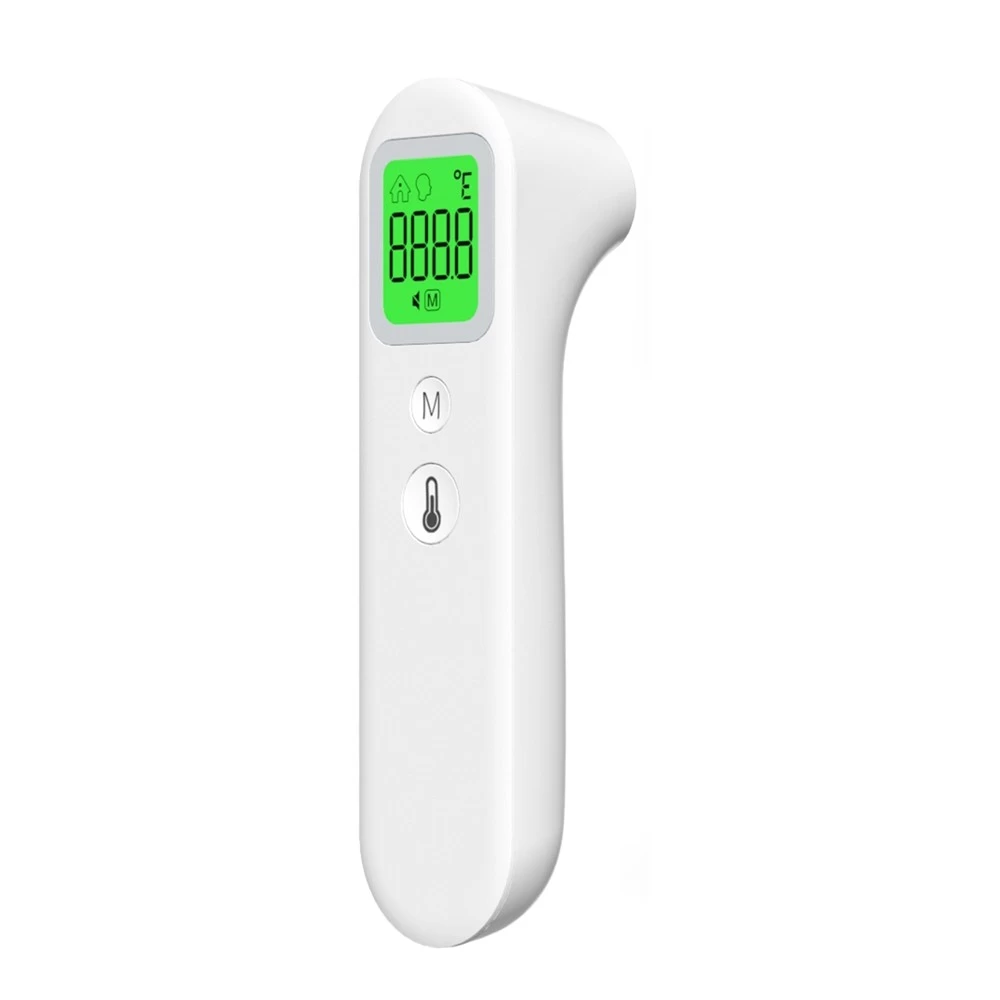
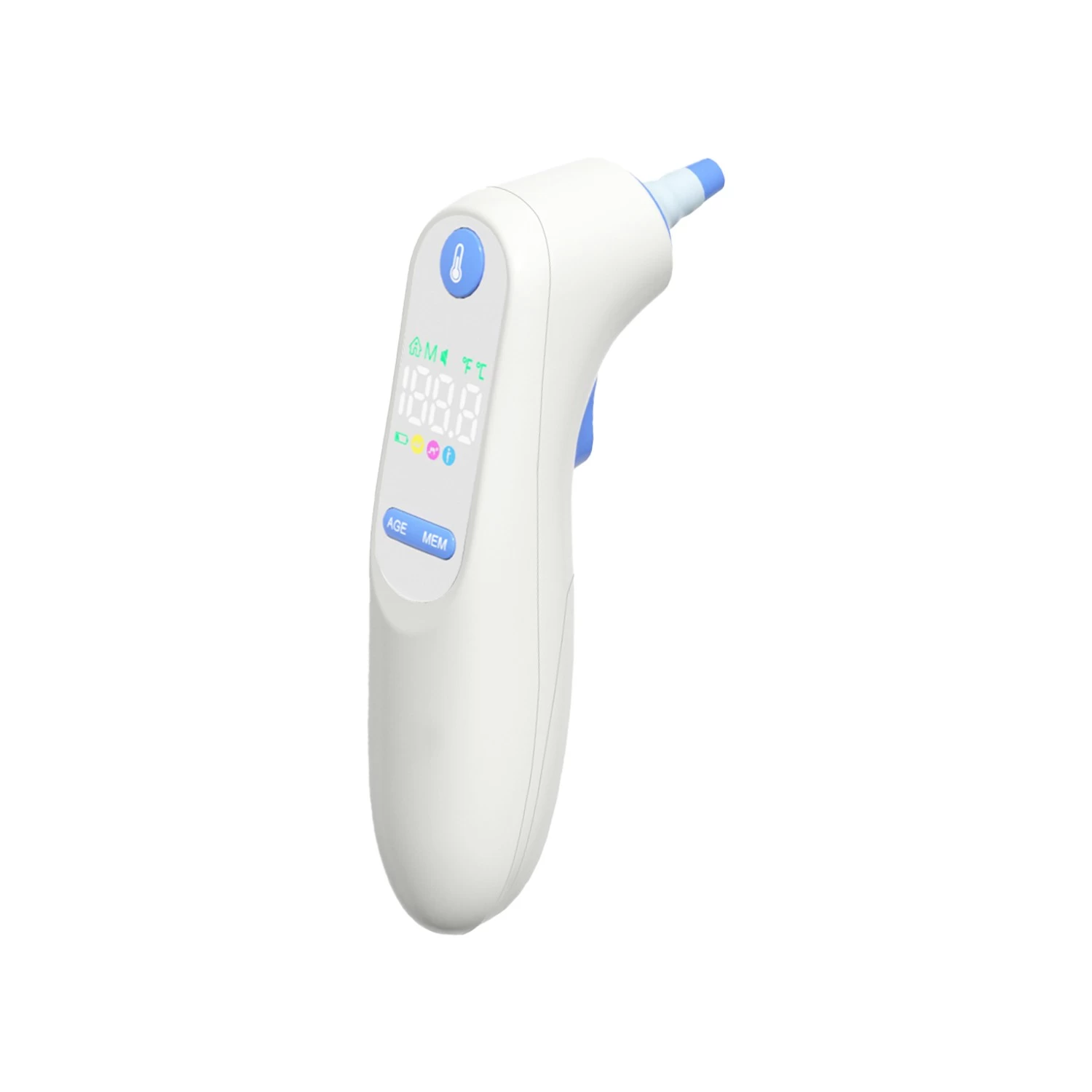
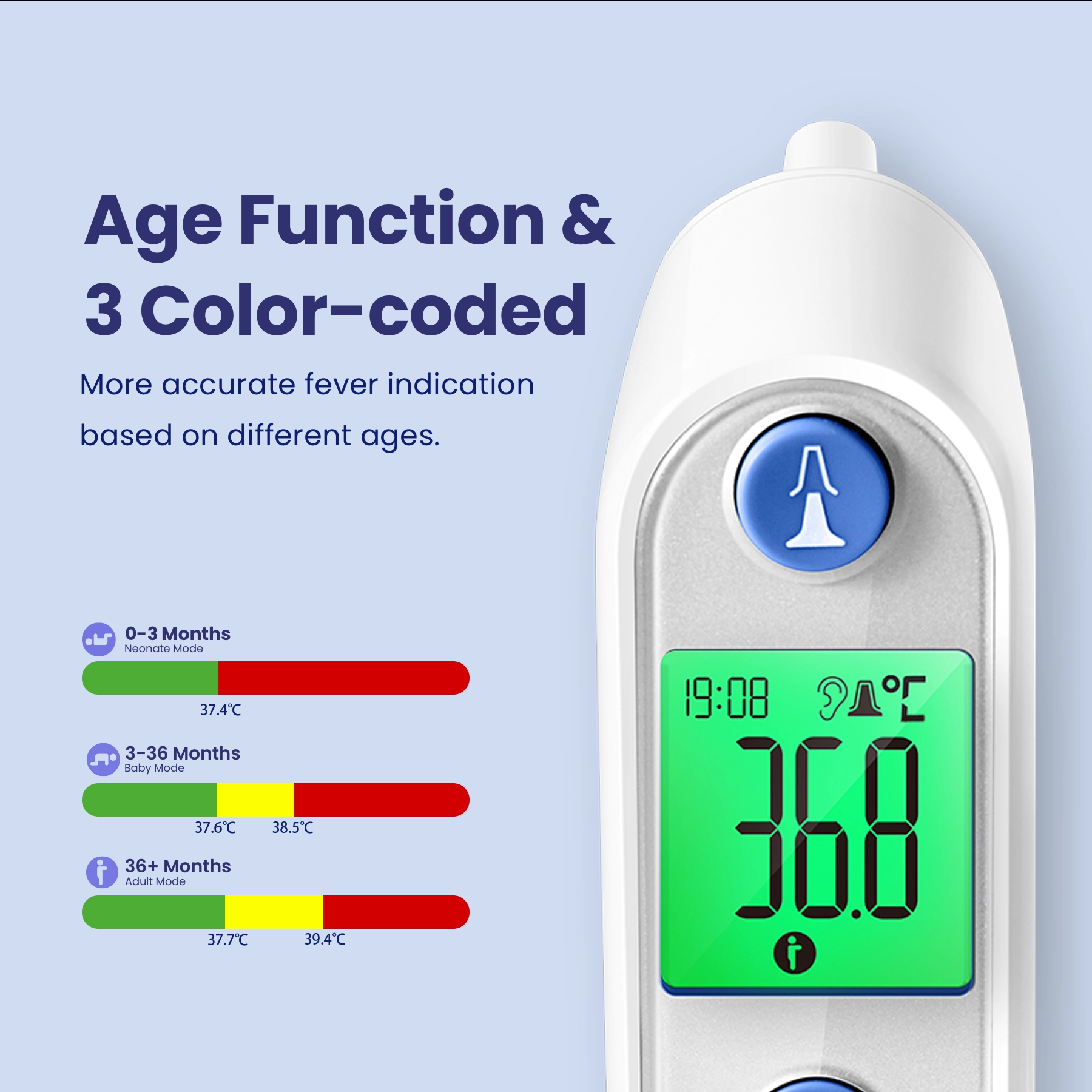
Finicare's infrared thermometers, such as the IR109, combine medical-grade sensor technology with consumer-friendly design. The IR109 features an ergonomic white body with a slightly curved profile, a green LCD display showing temperature readings in degrees Celsius, and two blue circular buttons for power and age or mode selection. The device supports both ear and forehead measurement modes, with a probe tip designed for gentle and accurate ear canal insertion.
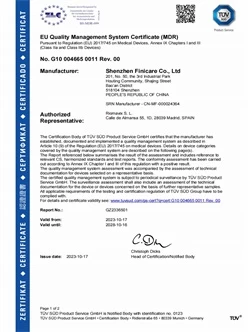
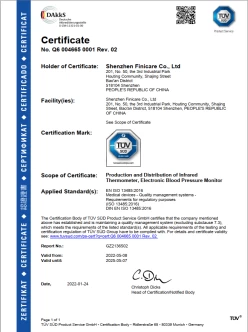
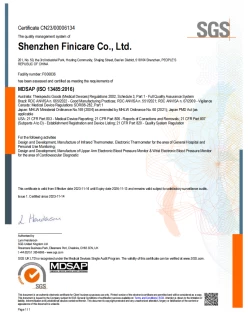
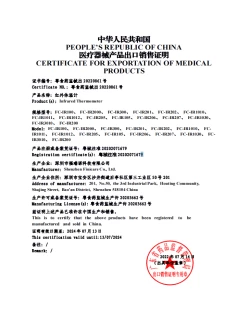
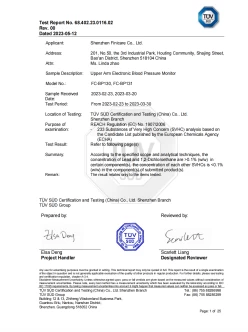
Every Finicare device carries FDA 510(k) clearance, CE (MDR), ISO 13485, and MDSAP certifications. The company's integrated quality system — from sensor calibration to ASTM E1965 and ISO 80601-2-56 compliance testing — ensures that each FDA approved infrared thermometer meets the same performance standards required for clinical use in the United States and European markets.
8. How to Verify a Thermometer Is Truly FDA Cleared
With the proliferation of low-cost thermometers on e-commerce platforms, verifying FDA clearance has never been more important. Here is how buyers can confirm that a device is genuinely an FDA approved infrared thermometer:
- Ask the manufacturer for their 510(k) number. This number starts with a "K" followed by six digits (for example, K201980).
- Search the FDA 510(k) database at accessdata.fda.gov to verify the clearance is active and matches the product.
- Check the FDA Establishment Registration number for the manufacturer.
- Review the product labeling for ASTM E1965 and ISO 80601-2-56 compliance statements.
- Look for CE MDR marking if the product is also sold in Europe.
- Be cautious of products that claim "FDA approved" but cannot provide a 510(k) number.
These steps are especially important for distributors, hospitals, and government procurement agencies sourcing an FDA approved infrared thermometer in bulk.
9. Common Pitfalls When Buying Infrared Thermometers
The market is flooded with inexpensive infrared thermometers that may not meet FDA requirements. Common pitfalls include:
- Purchasing devices that claim "FDA registered" but have no 510(k) clearance. FDA registration of an establishment is not the same as clearance of a device.
- Buying industrial infrared thermometers repackaged as medical devices. Industrial devices are not subject to ASTM E1965 accuracy requirements.
- Choosing devices without published accuracy data. Reputable manufacturers specify accuracy as plus or minus 0.2 degrees Celsius in the clinical range.
- Ignoring environmental requirements. Even an FDA approved infrared thermometer will produce inaccurate readings if used outside the recommended temperature and humidity range.
- Failing to check the measurement distance specification. Each device has a specific optimal distance that must be followed.
10. The Future of FDA Regulation for Infrared Thermometry
The FDA's June 2025 final rule signals an evolving regulatory landscape. While certain clinical electronic thermometers have been exempted from 510(k) requirements, infrared thermometers with telethermographic functions remain subject to premarket notification. The FDA continues to monitor post-market performance and may issue additional guidance on accuracy across diverse user populations and environments.
Emerging technologies — including multi-wavelength infrared sensors, AI-powered artifact filtering, and smartphone-connected continuous monitoring — are pushing the boundaries of what an FDA approved infrared thermometer can do. Finicare's R&D team is actively developing next-generation algorithms that compensate for environmental variables, ensuring that future devices deliver accuracy that meets or exceeds current ASTM and ISO standards while maintaining the speed and convenience that make infrared thermometry the preferred choice for modern healthcare.
Summary
An FDA approved infrared thermometer is a Class II medical device that has received 510(k) clearance from the U.S. Food and Drug Administration, demonstrating substantial equivalence to a predicate device in safety and effectiveness. Buyers should verify clearance by checking the FDA 510(k) database for a valid K-number, confirm compliance with ASTM E1965 and ISO 80601-2-56 standards, and follow the FDA's proper use guidelines for accurate readings.
The June 2025 FDA final rule exempted certain clinical electronic thermometers from premarket notification, but infrared thermometers with telethermographic functions still require 510(k) clearance. Finicare's IR109 and similar certified devices combine medical-grade sensors, ergonomic design, and full FDA, CE, and ISO 13485 certifications to deliver trustworthy temperature measurements for home and clinical use. Understanding what FDA approval means empowers buyers to make informed decisions and avoid the risks associated with unvalidated devices.
References
1. U.S. Food and Drug Administration. "Non-contact Infrared Thermometers." Updated June 18, 2025. https://www.fda.gov/medical-devices/general-hospital-devices-and-supplies/non-contact-infrared-thermometers
2. I3C Global. "Clinical Thermometers FDA 510k Clearance and Approval." https://www.i3cglobal.com/fda-510k-for-clinical-thermometers/
3. U.S. Food and Drug Administration. "510(k) Clearances." https://www.fda.gov/medical-devices/device-approvals-and-clearances/510k-clearances
4. ASTM International. "ASTM E1965-98(2016): Standard Specification for Infrared Thermometers for Intermittent Determination of Patient Temperature." https://www.astm.org/e1965-98r16.html
5. International Organization for Standardization. "ISO 80601-2-56:2017: Medical electrical equipment — Clinical thermometers for body temperature measurement." https://www.iso.org/standard/67940.html